Platform on window, door, frame technology, hardware, roof and facade technology, security

In the window frame industry, production has long since ceased to be solely about machines. The real strength lies in how information flows through the process—from the moment an order is placed through to the production and delivery of the window frame.
When that flow of information is organized efficiently, it brings calm, speed, and reliability to the workshop. That is why more and more window frame manufacturers are opting for an approach in which data directly forms the basis for production—not by adding extra steps, but rather by logically linking steps together.
The power of automation lies in entering data just once. MatrixKozijn Project serves as the central foundation for this, right from the start. When a window frame is digitally modeled, that model contains all the necessary information: dimensions, profiles, machining operations, glass, hardware, and options. From that single data entry, production lists, order lists, and machine files can then be generated automatically.
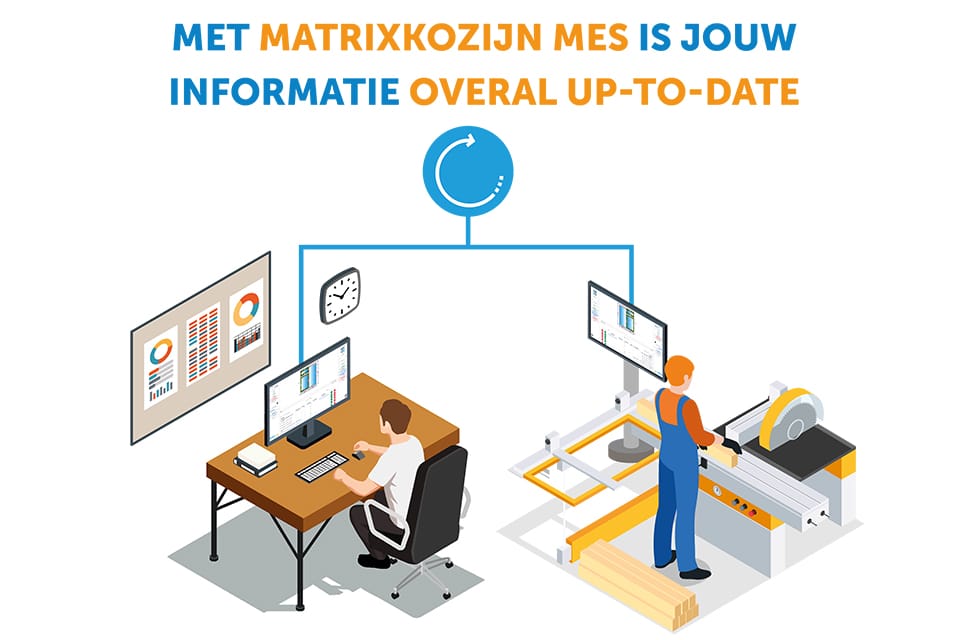
This same data thus forms the basis for cost estimates, quotes, and production. Information does not need to be re-entered or reinterpreted. This ensures a direct link between the office and the shop floor, allowing everyone to work with the same up-to-date data. A good example of this is MES (paperless factory management); the production planner updates the working drawing in Matrix Kozijn. Thanks to MES, updated working drawings are immediately available at the digital workstations on the production floor.
In modern window frame production, it is becoming increasingly common for machines to be controlled directly by software. Cutting lists are automatically generated from the calculation (from the work planning stage), and profiles are marked with barcodes that track the product throughout the entire process. Based on this data, machines automatically perform the correct operations. This results in a production process in which each step logically follows the next and no information is lost.
Employees have immediate access to the right data and can focus on monitoring and optimization instead of manual data entry. This not only makes the workflow more efficient, but also creates a calmer atmosphere on the work floor.
A key advantage of this approach is that information remains consistent. What is defined in work planning is implemented exactly as specified in production. Machining operations align with the selected profiles, and material usage is directly determined by the configuration. This ensures a reliable transition from work planning to production. Companies that take this step find that their production not only runs faster but, above all, becomes more predictable. Deviations decrease, and processes become easier to manage.
Automation does not replace craftsmanship in the workshop; rather, it enhances it. By taking over repetitive and precision-based tasks, automation creates room for work where knowledge and experience make the difference. Think of assessing quality, optimizing processes, and resolving specific situations. Take a damaged window frame, for example: you take a photo of the damage and attach it to the project in MES.
This way, it's clear what's wrong, and it's easy for all your coworkers to find.

In practice, automation is used for tasks such as sawing and milling profiles, preparing parts for assembly, and various other operations in the process. This leads to higher
precision, less material waste, and a more efficient use of personnel. The result is a production process in which technology and craftsmanship complement and reinforce each other.
Automation not only ensures speed, but also provides insight. Because production is directly linked to the underlying data, you can see at any given moment what is being produced, where an order is in the process, and what steps are still to come. This transparency makes it possible to plan better, adapt more quickly, and deliver more reliably.
This is increasingly supported by digital workstations on the shop floor. Employees have direct access to drawings, lists, and instructions, ensuring that information is always available and up to date. This prevents misunderstandings and ensures that work can be carried out without interruption. With MES, employees on the shop floor have continuous access to up-to-date drawings, production data, and project information.
The window frame industry is moving toward smaller production runs and greater variety. Customers expect customization combined with short lead times. It is precisely in this combination that the power of automation lies. When the foundation is set up in a stable manner, the process remains manageable, even as the number of orders increases. Multiple projects can be processed simultaneously without adding extra complexity.
The structure of the process remains intact, ensuring that growth does not automatically lead to increased pressure on the organization. Automation makes it possible to produce flexibly while maintaining control over quality and lead time.
The biggest change lies not only in the technology, but above all in the way processes are organized. Whereas cost estimation, work planning, and production used to operate separately, these steps are increasingly being integrated into a single, continuous workflow. Information is recorded once and then reused at every subsequent step.
As a result, the number of handoffs decreases, and reliance on individual knowledge is reduced. The process becomes more transparent and manageable, giving organizations greater control over their day-to-day operations.
Automation is therefore not an end in itself, but a means of creating structure and ensuring that processes flow logically from one to the next. Within MatrixKozijn, this ensures that estimating, work planning, production, and delivery are seamlessly integrated. This practical approach is also reflected in the software and the guidance provided. Many employees at Matrix Software have firsthand experience in the window frame industry, ensuring that processes align naturally with the day-to-day operations of manufacturing companies.
The time from order to machine is getting shorter and shorter. Not by working harder, but by organizing more efficiently. Companies that opt for an automated conversion of data into production are building a stable and future-proof process. Information flows directly to the shop floor, machines are controlled efficiently, and employees can focus on tasks where craftsmanship makes the difference.
In addition, this way of working makes it easier to train new employees. Because processes are defined in the system and information is centrally available, new colleagues can get up to speed more quickly. They work within the same structure and have immediate insight into what needs to be done, without relying on verbal instructions. This creates a production environment that is ready for growth, variation, and further digitization. An environment where clarity, reliability, and efficiency go hand in hand.
Neem dan rechtstreeks contact op met Matrix Software.
 Contact opnemen
Matrix Software - software for frame production Specialized in frame production Matrix Software develops specialized software for frame and window manufacturing companies. Since 1983, we have supported manufacturers in designing their processes more efficiently, from calculation and quotation to work preparation and production. Our solutions are fully tailored to the practice of window frame manufacturers and help reduce [...]
Bekijk Bedrijfsprofiel