Platform on window, door, frame technology, hardware, roof and facade technology, security
The themes of sustainability and the circular economy are characteristic of our current society. At Hydro, they don't just think sustainably, they have been putting it into practice for quite some time. Proof of this is the new Hydro CIRCAL 75R production technology, an alloy consisting of at least 75% post-consumer recycled aluminum. This technology is also used in the production of the new minimalist Artline sliding system from the Sapa brand.

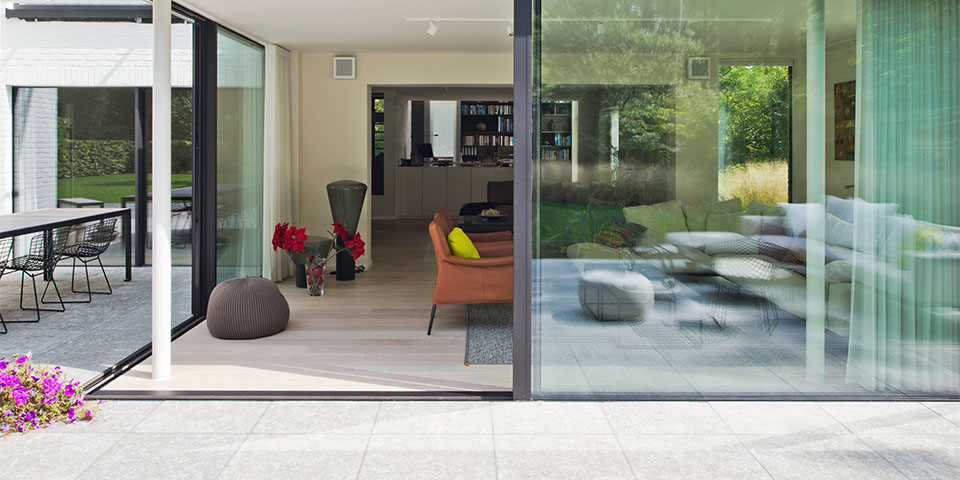
Artline is a thermally broken aluminum sliding system with a slim appearance at the height of the
Center hook starting at just 26 mm, ideal for large glass (sliding) walls up to a height of no less than 3.5 meters. (Image: www.fotovanhuffel.be)
Hydro, Sapa's parent company, uses windows, doors, and curtain walls from buildings that have reached the end of their useful life to manufacture new aluminum building systems that meet current and even future needs and requirements. This means that only 51% of the energy required for primary aluminum production is consumed, and CO₂ emissions are also reduced.2emissions are significantly reduced. Thanks to its scientifically based approach, Hydro has two European production facilities in Dormagen and (Germany) and Clervaux (Luxembourg), which reintroduce fragmented, sorted, and processed post-consumer scrap waste from construction into circulation. This enables the production of a high-quality alloy with high purity. The various steps in the aluminum recycling production process are certified by the Norwegian label DNV-GL.

The perfect interplay of glass and invisible frames ensures optimal light incidence and creates a slim and elegant appearance, even with large, openable windows.
The Sapa brand will soon be applying CIRCAL 75R technology, an alloy developed from at least 75% post-consumer recycled aluminum, to its minimalist Artline sliding system. Artline is a thermally broken aluminum sliding system with a slim profile at the center hook, measuring just 26 mm. This sliding window is ideal for large glass (sliding) walls, motorized or not, up to a height of no less than 3.5 meters. The perfect interplay of glass and invisible frames ensures optimal light incidence and creates a slim and elegant appearance, even with large automated windows. These large glass sections also result in a smooth transition between indoors and outdoors with an unrestricted view of the surroundings.

(Image; Marco Kessler)
“The Artline frame, with a construction depth of 125 mm, is ideal for glass sections with a height of up to 3 meters and a maximum glazing thickness of 42 mm and a weight of up to 320 kg. The Artline XL for heights of up to 3.5 meters is available with sashes weighing up to 500 kg, and even up to 1200 kg on request. This system with quadruple double rollers in stainless steel or plastic has a frame depth of 150 mm and includes sashes 57 mm deep with a maximum glazing thickness of 52 mm,” says Perry Hermans, country manager for Hydro Building Systems Netherlands. “This XL is also available with a roller mechanism that is integrated into the bottom profile, so that no aluminum is visible at the bottom, top, or sides, and transparency increases to 99%.” Artline and Artline XL are synonymous with optimal thermal and acoustic insulation, and all versions guarantee excellent water and air tightness and wind resistance. At Polyclose, the Artline open corner in combination with Renson's Panovista Max was a real eye-catcher.