Platform on window, door, frame technology, hardware, roof and facade technology, security
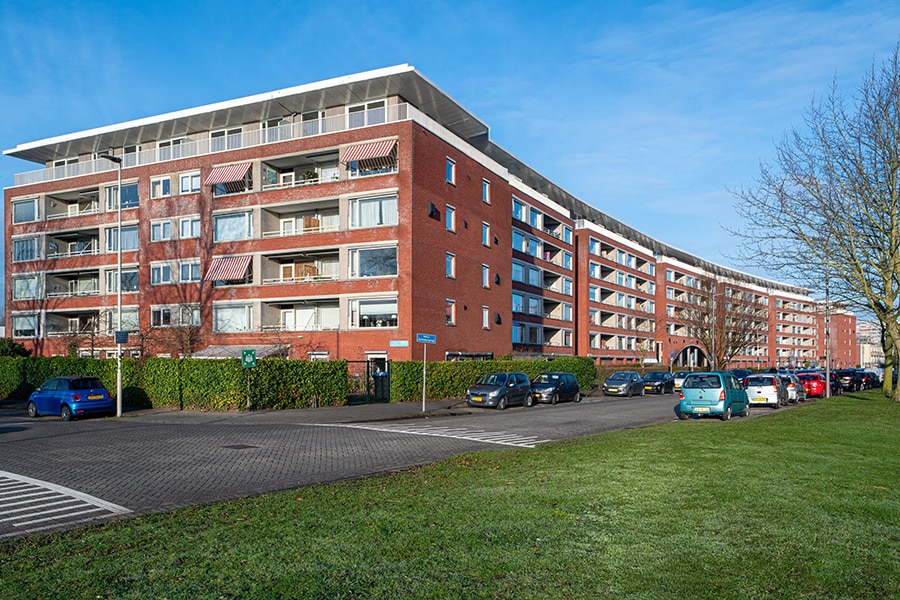
Adding an extra residential floor on the highest layer of a residential building can use factory prefabricated wood construction to rapidly increase the number of homes. This is proven by the addition of 44 wood-built homes on the roof of residential building for the elderly De Klapwiek in Rotterdam. Says project architect Willeke Smit of EGM architects in Dordrecht, “If you work out the entire plan down to nail level, you can minimize construction time and construction nuisance on site.”
It is well enough known. Due in part to scarce and expensive building land, grid congestion, staff shortages and lengthy procedures, too little is being built, especially in social housing. Research shows that topping up could provide about 100,000 additional homes by 2030. To realize this potential, the national approach optoppen was developed in 2024 with a joint core team of the Ministry of the Interior and Kingdom Relations, the province of South Holland and Aedes. This approach aims to facilitate, scale up and standardize optoppen. And that's not for nothing. By 2024, sixteen housing associations will have realized 131 housing units by topping up; 1,209 homes are still being developed. That is a fraction of what is possible.
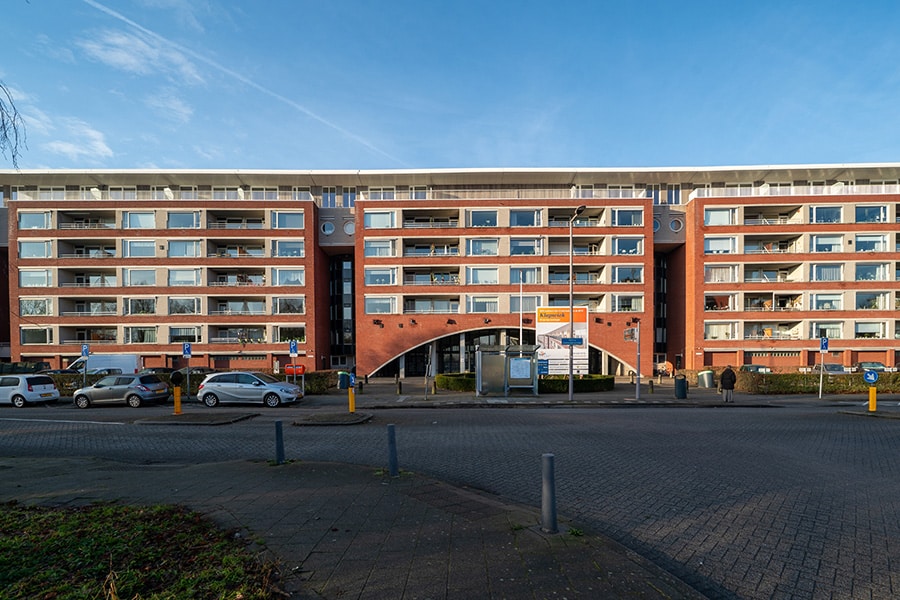
De Klapwiek in Rotterdam is the first optop project of the Rotterdam Elderly Housing Foundation. In the coming years, SOR will be adding more affordable energy-efficient homes to the current housing stock. In doing so, the corporation is focusing on transformation, house splitting and sharing, new construction and optopopping. On top of De Klapwiek's existing life-capable apartments, a total of 44 social housing units in wood construction were recently built on six and locally five layers. EGM architecten in Dordrecht signed for both the original and the new design.
Project architect Willeke Smit says, “In the 1990s, construction was done with little excess. Research showed that the roof of De Klapwiek could handle a single extra layer, provided it was done in a light construction method. So together with SOR, we settled on timber construction and engaged Dura Vermeer. The assignment from both SOR and Welstand was to create a high-quality construction with character. With light-colored wooden cladding of low-maintenance thermally modified fraké and wooden window frames, we succeeded.”
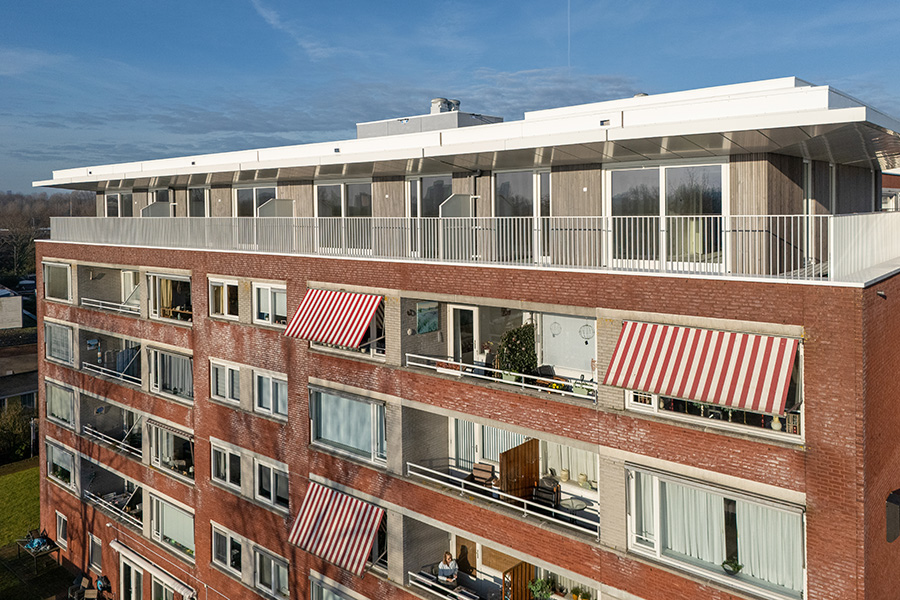
Toppling is custom work. Smit: “Here we had to deal with a slight arch in the facade and height differences in the roof. That shape was maintained. The raising did make it possible to give the new volume a canopy that renews and strengthens the appearance of the building.”
The new wood-built apartments come from the factory and rest on a steel beam for even weight distribution. They are built around a wooden nave-wide 3d container, called the smartbox, containing the apartments‘ installations, bathroom and kitchen. The box concept has since been incorporated by Dura Vermeer into its palette of housing concepts with ’Blokje Op‘ as a wooden ’optop concept. For the Klapwiek, this box was delivered ready-made by timber builder De Groot Vroomshoop and attached to the original building. DGV also fabricated in 2D the CLT floor and timber frame wall and roof elements for assembly on site. The elevator was extended to the new floor.
Smit: “With prefab you not only save on construction time, but also minimize the number of construction movements on site. And thus the inconvenience for the residents who could stay in their homes during construction.” The ’little train’ of parties involved realized four homes per week. The entire construction took a year. By choosing sustainably remodeled wood for both the supporting structure, roof, window frames and façade finishes, most of the material use is non-virgin and/or biobased.
After the successful realization of De Klapwiek, EGM sees great potential for new optopprojects. The architectural firm therefore offers clients the possibility of a so-called quick scan. Smit: “In this, we do research for the owner into the spatial design, the urban integration, the quality of the support structure, the number of homes and the lifespan of the installations of his property. An optop residence is relatively expensive because it is actually a single-story building, not as compact and existing installations have to be taken into account. It's a real fit-in puzzle. Experience shows that in most cases the midlife renovation of a building is cost wise a good time to tackle this.” Those who opt smartly can use the rental or sales proceeds from the additional homes to improve the existing property. And that's good news for owners of post-war 3- and 4-story apartments in particular.
Neem dan rechtstreeks contact op met Dutch Trade Association for the Carpentry Industry (NBvT).
 Contact opnemen
The Dutch Trade Association for the Carpentry Industry (NBvT) is a trade association that is primarily there for its members, combines forces and promotes interests. The NBvT supports its members in the areas of marketing, advice, networking, innovation, standards and regulations, environment, technology, personnel and organization. Together with its members, the NBvT works to further increase [...]
Bekijk Bedrijfsprofiel